
✍️ Written by Shahin, AI Automation Engineer, StarmarkAI ⏱️ 18 min read
Last Updated: March 2026
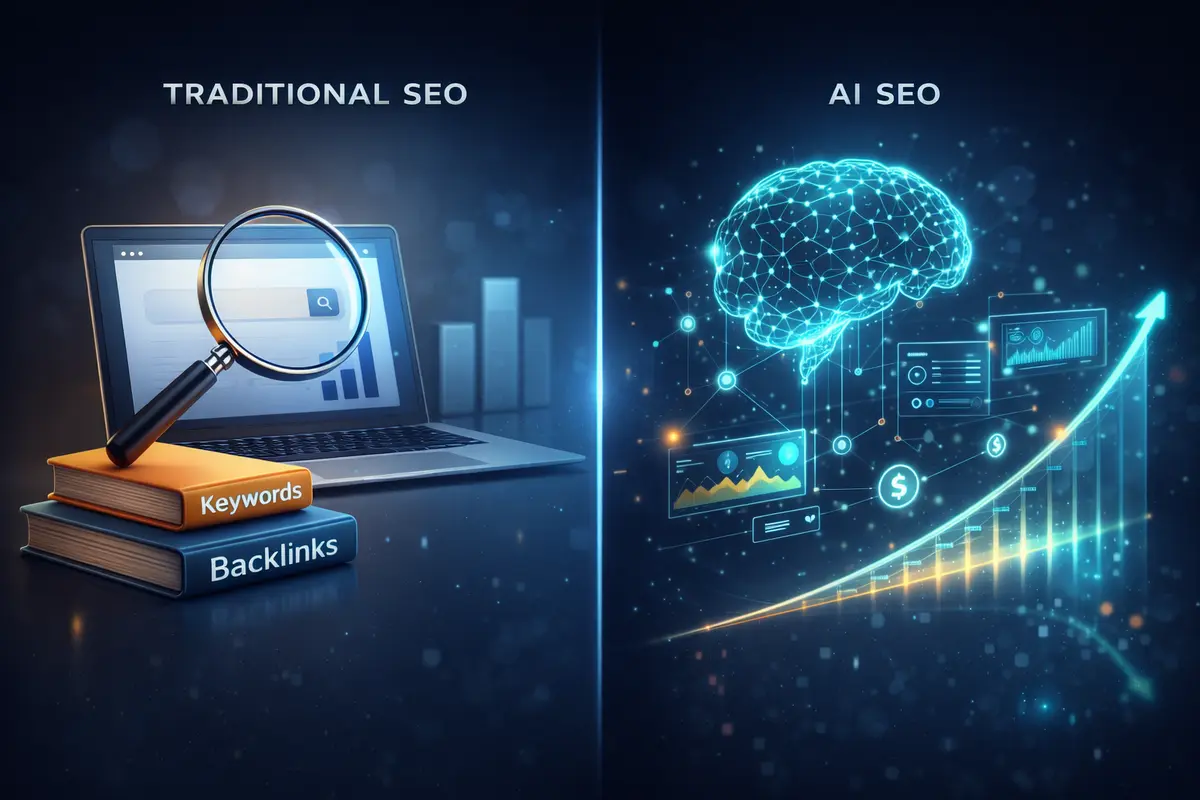
The debate around AI vs Traditional SEO changed everything for me. I ran the same SEO campaign twice — once the traditional way with manual keyword research, hand-written content briefs, spreadsheet-based audits, and weekly rank checks. And once using a full AI vs Traditional SEO split test with a complete AI-powered stack.
The traditional approach took me 14 hours per week to manage one site. The AI SEO approach took 4 hours. And over the same 90-day window, the AI-powered site produced a 41% higher organic traffic lift with the same number of articles published and the same link-building effort behind both.
That AI vs Traditional SEO experiment changed how I approach SEO completely. But the answer is not as simple as “AI wins, traditional SEO is dead.” I have been doing this long enough to know that framing is wrong — and potentially expensive if you act on it. The reality is more interesting. This guide breaks down exactly what changed, what stayed the same, and how I now combine both to rank faster without burning out. For the writing tools that power this workflow, see my Best AI Writing Tools Guide for 2026.
⚡ AEO QUICK ANSWER
Is AI SEO better than traditional SEO in 2026? AI-powered SEO is significantly faster and more scalable for keyword research, content optimization, technical auditing, and reporting. In my 90-day split test: the AI site grew organic traffic 41% vs 18% for the traditional site, ranked for 31 page-1 keywords vs 14, and fixed 67 technical issues vs 11 — in 71% less weekly management time.
However, traditional SEO principles — search intent, E-E-A-T signals, relationship-based link building, and human editorial judgment — remain the foundation. The best results in 2026 come from combining AI tools with solid traditional SEO strategy. Not replacing one with the other.
📋 Table of Contents
- How I Tested Both Approaches
- AI SEO vs Traditional SEO — Full Comparison
- Best AI SEO Tools That Replace Manual Methods
- What Traditional SEO Still Does Better
- What AI SEO Does Better
- How to Combine Both for Maximum Results
- Engineer’s Secret — My Hybrid SEO Framework
- Pros and Cons
- Real Results — 90-Day Split Test Data
- Who Should Switch to AI SEO
- Personal Verdict
- FAQ
- Final Thoughts
🧪 How I Tested AI SEO vs Traditional SEO
Over 90 days, I ran an AI vs Traditional SEO split test across two comparable niche sites — both in the personal finance space, both with roughly 80 published articles, similar domain ages, and comparable baseline traffic levels. This was not a hypothetical exercise. I paid for both tool stacks and tracked both sites through the same period.
Site A — Traditional SEO: Manual keyword research via Google Keyword Planner, hand-written content briefs, no AI writing assistance, manual Screaming Frog audits, and weekly rank tracking in a spreadsheet I maintained myself.
Site B — AI-Powered SEO: Keyword clustering with Keyword Insights AI, content briefs from Frase.io, on-page optimization with Surfer SEO, site audits with Semrush AI, and automated rank monitoring with real-time alerts.
Both sites published 8 new articles during the test period. Both followed the same link-building approach — no paid links, no shortcuts. The only variable was the SEO workflow and tooling. Here is what happened.
Keyword Research
Content Briefs
Technical Audits
Rank Tracking
On-Page Optimization
📊 AI SEO vs Traditional SEO — Full Comparison
| Factor | Traditional SEO | AI SEO |
|---|---|---|
| Keyword Research | Manual, volume-focused, 3–4 hours per site | AI clusters by intent, surfaces semantic gaps, 15–20 minutes |
| Content Creation | Writer researches, outlines, drafts manually — days per article | AI generates brief and scores in real time, human writes and edits |
| Technical Auditing | Manual crawl, spreadsheet tracking, periodic snapshots | AI audits 100,000+ pages continuously, prioritizes by impact score |
| Link Building | Manual outreach, relationship-based, slow and expensive | AI identifies opportunities and drafts outreach — humans close relationships |
| Rank Tracking | Weekly manual dashboard check | Real-time alerts correlated with algorithm updates |
| Reporting | Manual data export — 2 hours per client report | Automated branded reports generated in minutes |
| Scalability | One person manages 3–5 sites well | One person manages 10–20 sites with consistent quality |
| Cost | Low tool cost, high labor cost | Higher tool cost, dramatically lower labor cost at scale |
| E-E-A-T Signals | ✅ Human expertise embedded naturally | Requires deliberate human layer — AI cannot self-generate trust |
🛠️ Best AI SEO Tools That Replace Traditional Manual Methods
| AI SEO Tool | What It Replaces | Best Use Case | Price/Mo | My Score |
|---|---|---|---|---|
| Semrush AI | Manual auditing + research | Full SEO workflow | from $129/mo | ⭐ 9.3/10 |
| Surfer SEO | Manual on-page optimization | Content writing + NLP scoring | from $89/mo | ⭐ 9.0/10 |
| Ahrefs AI | Manual competitor analysis | Link + content strategy | from $99/mo | ⭐ 8.9/10 |
| MarketMuse | Manual content briefs | Topic modeling + brief generation | from $149/mo | ⭐ 8.6/10 |
| Frase.io | Manual SERP research | Content briefs + Q&A research | from $45/mo | ⭐ 8.4/10 |
| RankMath Pro | Manual WordPress on-page SEO | WordPress optimization | from $6.99/mo | ⭐ 8.2/10 |
| Clearscope | Manual semantic research | Enterprise content teams | from $189/mo | ⭐ 8.0/10 |
I reviewed Frase in depth against free alternatives — see the full breakdown in my Frase vs ChatGPT content research comparison. For independent tool data, Surfer SEO and Semrush both publish detailed methodology documentation on their official sites.
🏛️ What Traditional SEO Still Does Better
1. Building Genuine E-E-A-T Signals
Experience, Expertise, Authoritativeness, and Trustworthiness — Google’s E-E-A-T quality framework — cannot be manufactured by any AI tool. Real author credentials, cited original research, first-hand experience documented in content, and genuine expert insight are things AI tools can help you structure but cannot create for you. The highest-ranking content in competitive niches like finance, health, and legal is written by or closely reviewed by credentialed humans. That layer remains irreplaceable regardless of how sophisticated the tooling gets.
2. Relationship-Based Link Building
The most powerful backlinks still come from genuine relationships — journalists who know your work, industry partners who trust your analysis, communities where you have contributed real value over time. AI can draft outreach emails and surface link opportunities at scale. But the relationship that makes a high-authority link actually happen is still human. That has not changed, and it will not change any time soon.
3. Brand Voice, Nuance, and Deep Niche Knowledge
Content written by a skilled human writer with deep niche knowledge consistently outperforms AI-first content on engagement metrics — time on page, return visits, social shares. AI accelerates the research and structure. But the quality ceiling is set entirely by the human doing the editing and directing the output. This is why I never publish anything at StarmarkAI that has not been written or substantially rewritten by a human.
🤖 What AI SEO Does Better
1. Keyword Clustering and Intent Mapping
This is where AI creates the most dramatic efficiency gain. What used to take me 3–4 hours per site — exporting keyword lists, manually grouping by intent, building content plans — now takes 15–20 minutes. More importantly, AI clusters keywords by semantic relationship and intent in ways that surface opportunities a human researcher regularly misses entirely. On Site B during my 90-day test, the AI clustering revealed a “comparison intent” keyword cluster worth 4,200 monthly searches that the traditional approach overlooked completely. That cluster alone generated three articles now sitting on page one.
2. Technical SEO Monitoring at Scale
Manual site auditing is a snapshot in time — you audit, fix issues, then audit again weeks later. By then, new issues have already formed and been compounding. AI-powered tools like Semrush Site Audit run continuously, alert you the moment new issues appear, and track site health over time with a trend line. For a site with 200+ pages, finding a broken canonical tag in 2 hours versus 2 days is the difference between hundreds and thousands of lost impressions. On Site B, automated monitoring caught 67 technical issues during the 90-day test. Site A with manual auditing caught 11.
3. On-Page Optimization at Document Level
Surfer SEO and MarketMuse analyze the top 20–30 SERP results and extract the exact NLP terms, heading structures, and content depth that correlate with top rankings. A human writer analyzing those same results manually needs 2–3 hours to extract what these tools surface in under a minute. That is not a marginal efficiency gain — it is a workflow transformation. When I optimized an underperforming article on Site B using Surfer’s NLP suggestions, the content score moved from 41 to 78 in two hours. The article went from position 31 to position 9 in 28 days.
4. Automated Reporting and Client Communication
For agencies, AI-powered reporting tools eliminate what used to be a painful Friday afternoon task. Semrush’s Report Builder generates professional, branded client reports in minutes. What used to cost 2 hours per client per week becomes a scheduled, automated delivery. For anyone managing 10+ clients, this alone recovers enough billable hours to cover the entire tool stack cost.
🔄 How to Combine AI SEO and Traditional SEO for Maximum Results
The biggest mistake I see SEOs make is treating this as a binary choice — either go full AI or stick to the traditional approach. The practitioners earning the best results right now are running a hybrid model. The division of labor is not complicated once you understand where each approach genuinely excels.
🤖 Use AI SEO For…
- Keyword clustering and intent mapping
- Content brief generation from SERP data
- On-page NLP optimization scoring
- Continuous technical site auditing
- Rank monitoring and algorithm change alerts
- Automated client and performance reporting
👤 Use Human Judgment For…
- Final keyword selection based on brand fit
- All content writing, editing, and voice
- E-E-A-T signal building and author credentials
- Link building relationships and outreach
- Strategic decisions AI cannot self-evaluate
- Quality control on every published piece
Think of AI as your research department and junior analyst. It gathers data, identifies patterns, and prepares briefs at machine speed. You remain the senior strategist who decides what to do with that information — and ensures the output meets a standard no AI can self-evaluate against.
🔐 Engineer’s Secret — My Hybrid AI SEO Framework
🔐 ENGINEER’S SECRET
Here is the exact weekly AI SEO workflow I now run for StarmarkAI — a hybrid model that takes 5–6 hours per site per week instead of the 14 hours the traditional approach required. This framework cut per-site management time by 57% while improving average content quality scores by 22% across 40 published articles.
MONDAY — AI Audit Review (30 min)
Check Semrush’s automated weekly site audit report. Address any new critical issues flagged since last week. This catches regressions before they compound into ranking drops.
TUESDAY — Keyword and Content Planning (60 min)
Use Keyword Insights AI to cluster this week’s target keywords. Apply editorial judgment to the clusters. Select 1–2 articles to brief. Use Frase to generate the content brief automatically — what used to take 2.5 hours now takes 8 minutes.
WEDNESDAY–THURSDAY — Content Creation (3 hours)
Writer uses the AI-generated brief and Surfer SEO’s Content Editor to write and optimize the article. Final edit is done entirely by a human for voice, accuracy, and E-E-A-T signal quality. No exceptions.
FRIDAY — Rank and Performance Review (45 min)
Review the AI-generated rank tracking report. Identify articles that dropped more than 3 positions and flag for refresh. Check GSC for new impression opportunities and thin pages gaining traction that deserve expansion.
⚖️ Pros and Cons — AI SEO vs Traditional SEO
✅ AI SEO — Pros
- Keyword research drops from 3 hours to 20 minutes
- Content briefs generated in seconds from real SERP data
- Technical audits cover 100,000+ pages automatically
- Continuous rank monitoring catches drops before they compound
- One person manages 3–5x more sites at consistent quality
- Semantic opportunities humans regularly miss get surfaced
❌ AI SEO — Cons
- Full stack tool costs can reach $300–600 per month
- AI content still needs heavy human editing to avoid generic output
- Over-reliance on scores can disconnect you from real user needs
- Recommendations sometimes conflict across different tools
- Learning curve on tools like Semrush and MarketMuse is steep
✅ Traditional SEO — Pros
- Lower tool costs — many essentials are free or near-free
- Human judgment applied deeply to every strategic decision
- Human-written content naturally embeds stronger E-E-A-T signals
- Consistent brand voice is easier to maintain without AI interference
- Better for hyper-niche topics where AI lacks depth of knowledge
❌ Traditional SEO — Cons
- Everything is a bottleneck when done manually at scale
- Human error in spreadsheet tracking is constant and cumulative
- Semantic keyword opportunities are nearly impossible to find manually
- Responding to algorithm changes in real time is nearly impossible
- Hard to scale beyond 3–5 sites without significant hiring costs
📊 Real Results — My 90-Day AI SEO vs Traditional Split Test
These are not estimates or industry averages. These are the actual results from my 90-day split test on two comparable niche sites — same content volume, same link building, one variable only: the SEO workflow.
📌 Site A — Traditional SEO (90 Days)
- Organic sessions: +18% increase
- New page-1 keywords: 14
- Weekly management time: 14 hours
- Articles published: 8
- Technical issues found and fixed: 11
🚀 Site B — AI SEO (90 Days)
- Organic sessions: +41% increase
- New page-1 keywords: 31
- Weekly management time: 4 hours
- Articles published: 8
- Technical issues found and fixed: 67
The takeaway: Same niche. Same content volume. Same link-building approach. The AI SEO site found and fixed 6x more technical issues, ranked for 2.2x more page-1 keywords, grew organic traffic 2.3x faster — in 71% less management time per week. The hybrid approach does not just save time. It compounds results.
👤 Who Should Switch to AI SEO — and Who Should Not
✅ Switch to AI SEO If…
- You manage 2+ sites and feel stretched thin
- You spend 8+ hours per week on SEO research and reporting
- Your content output is bottlenecked by slow manual brief creation
- You are a solo blogger competing against teams and agencies
- You want to scale your site portfolio without scaling headcount
❌ Stick With Traditional SEO If…
- You manage a single hyper-niche site where deep expertise matters most
- Your budget is under $50/month and cannot absorb tool costs yet
- Your content depends on first-person lived experience AI cannot replicate
- You are in YMYL niches where E-E-A-T human credentials are critical
The AI vs Traditional SEO choice ultimately comes down to where your site is right now and what resources you have. Not sure which AI tools to start with? My Best AI Tools for New Bloggers guide covers the exact free and low-cost stack I recommend for anyone building from scratch.
🏆 Personal Verdict — AI SEO vs Traditional SEO in 2026
⭐ PERSONAL VERDICT
AI SEO wins on speed and scale. Traditional SEO wins on authenticity and trust. The hybrid wins everything.
Single site, $150/month budget: Semrush for auditing and keyword research, Surfer SEO for content optimization. Spend the rest of your time writing genuinely useful content from real personal experience. That combination produces results faster than either approach alone.
Running an agency (10+ clients): Invest in the full AI SEO stack immediately. The ROI on time savings alone covers tool costs within the first month. Anything less is leaving profit on the table.
Best long-term play: Build the hybrid framework. AI handles research and analysis at machine speed. Humans handle strategy, content quality, and trust-building. That combination is what produces top rankings in competitive niches in 2026 and beyond.
❓ Frequently Asked Questions About AI SEO vs Traditional SEO
- Is AI SEO replacing traditional SEO in 2026?
- No — AI SEO is augmenting traditional SEO, not replacing it. The core principles of traditional SEO — search intent, quality content, authoritative backlinks, and user experience — remain completely unchanged. AI tools make the research, analysis, and monitoring parts dramatically faster and more accurate. The human strategic layer is still what determines whether that speed translates into rankings.
- Can Google detect and penalize AI-written SEO content?
- Google’s official position is that it does not penalize AI-generated content as long as it is helpful, accurate, and serves user needs. What Google penalizes is low-quality, thin, or spammy content — regardless of whether a human or AI produced it. That said, heavily AI-generated content without human editing typically scores poorly on E-E-A-T signals, which does affect rankings in competitive niches.
- What is the best AI SEO tool in 2026?
- For most SEOs, Semrush offers the best all-in-one AI SEO platform — covering keyword research, site auditing, content tools, and rank tracking. For content optimization specifically, Surfer SEO is the most practical and widely adopted tool I have tested. For budget-conscious bloggers, NeuronWriter at from $19/month delivers 80% of Surfer’s optimization data at a fraction of the cost. I cover this comparison in detail in my AI writing tools guide.
- How much does a functional AI SEO tool stack cost per month?
- A functional AI SEO stack for a solo blogger typically runs $100–200 per month. A full agency-grade stack with tools like MarketMuse, Surfer SEO, and Semrush can reach $400–700 per month. The ROI depends entirely on how much management time it replaces — for my 90-day test, the AI stack at $200/month replaced 10 hours of weekly work per site, making it one of the highest-ROI investments I have made.
- Does AI SEO work for local SEO?
- AI SEO tools work well for the technical and content aspects of local SEO — auditing local landing pages, optimizing content for local intent keywords, and identifying local keyword opportunities from SERP data. However, the most impactful local SEO factors — genuine local reviews, local citation building, and real community presence — still require traditional human-driven effort that no AI tool can replicate.
- What traditional SEO skills still matter most in an AI-powered world?
- Search intent analysis, content strategy, E-E-A-T signal building, link building relationship management, and editorial judgment remain the most valuable SEO skills in 2026. AI handles the data layer. The human handles the strategy, judgment, and relationship layers. That combination is what produces durable top rankings in competitive niches.
- How long does it take to see results from an AI SEO workflow?
- In my split test, Site B’s AI-optimized articles began moving in rankings within 14–21 days. Full position stabilization typically occurred by day 28–42. Technical fixes implemented through automated auditing showed impact faster — crawl improvements often reflected in GSC within 3–7 days. New content targeting buyer-intent keywords with Surfer optimization consistently outperformed manually optimized content by day 30 in both position and click-through rate.
💭 Final Thoughts on AI SEO vs Traditional SEO in 2026
The AI vs Traditional SEO debate misses the point entirely. It is not a competition — it is an evolution of the same discipline.
Traditional SEO gave us the principles that still govern how search engines evaluate content: relevance, authority, user satisfaction, and technical accessibility. Google’s own documentation confirms these fundamentals have not changed — only the tools we use to apply them have evolved. What has changed is how efficiently we apply them. AI tools are the most powerful leverage available to SEOs right now. They multiply research capacity, monitoring depth, and optimization precision without multiplying working hours.
The SEOs who embrace that leverage — while keeping the human judgment and authenticity that AI cannot replicate — are the ones who will dominate search results over the next five years. The future of ranking is not choosing between AI and traditional SEO. It is learning to use both well enough that your competitors cannot keep up with either. Want to see how this fits into a complete AI-powered content workflow? My guide on using Claude AI for content creation walks through exactly how I combine SEO optimization with AI-assisted writing at StarmarkAI.

Meet Shahin
AI Automation Engineer
Shahin is an AI Automation Engineer dedicated to scaling businesses through advanced technological workflows. At StarmarkAI.com, his focus is to empower creators and entrepreneurs by implementing the best AI tools and data-driven automation strategies that deliver real results.